Monday, July 13, 2015

Lastings Milledge and the Danger of Personal Favorites

I'm a bad scout. This is something I've always known about myself, and it's probably time for me to just come out and admit it in a public forum. My name is Nick Nelson, and I don't know anything about transferable talent beyond a fantasy baseball team.


Allow me to explain. When I was about 19, my family moved to Norfolk, Virginia, home of the Tides. While they are now the AAA affiliate of the Baltimore Orioles, back in 2006 they were a New York Mets affiliate at the same level. Playing for them was a hotshot 21-year-old outfielder from Bradenton, Florida by the name of Lastings Milledge. He wasn't much of a power threat, but God had blessed this kid with what seemed like solid plate vision and plus speed. He was all those clichés everyone talks about. Fast, gritty, guts out those ground balls, always gets his uniform dirty. Et cetera, et cetera, ad infinitum. I got his prospect card from a vendor at Harbor Park and eagerly awaited his call-up. It came at the end of May. I was right. This kid was going to be a star.


Milledge as a Met. credit: alpineinc (Flickr)
Let's just say I won't be getting any calls from Major League organizations any time soon. Milledge played a total of 115 games for the Mets over two seasons (2006-2007) before being traded to the Washington Nationals in the offseason. There were reports of him being a bad clubhouse guy. Reports of letting the spotlight get to him. In 2007, he dropped a guest verse on a childhood friend's rap song, using lyrics that are unprintable on a family blog. The Mets, wanting to avoid needing a parental advisory for their fandom, issued a statement saying, "We disapprove of the content, language and message of this recording, which does not represent the views of the New York Mets."


This might have been the death knell. He would go on to play in more than 100 games only twice in his career (138 in 2008 with the Nationals, 113 in 2010 with the Pirates), and was out of the league entirely after just two games with the White Sox in 2011. He still plays internationally, manning an outfield spot with the Tokyo Yakult Swallows, where he has been since 2012.

Now, of course this doesn't mean he failed. He played a children's game and was paid handsomely to do so. He turned a sport into a career, something that countless boys and girls across the world dream of doing. Even if his Major League career was a brief six seasons, that's still more than most baseball players will ever see. I understand that. I do. But I also know that I thought this kid had star written all over him. I saw him as a late-round sleeper in a couple years, and I expected to see his name on t-shirts in no time. He had an MLB career, but I had expected an All-Star career.


I'm Fern, and all of my favorites are Wilbur. credit: Hanna-Barbera
There are lessons to be learned here. You can't like a guy just because he has a "good look." A few games in the minors aren't enough to think he'll "be somebody." Perhaps the most important, though, is this: baseball is a business, and business should never get personal. As a fan, sometimes you have to divorce yourself from the idea of holding onto all of your favorite guys if you want to win. I'm trying to hone my craft a little more finely, but I've certainly bought a few player t-shirts that have gotten me into a bit of embarrassment. Sorry, Kosuke Fukudome, Junior Lake, and end-of-career Derrek Lee. My lesson to you? Pick favorites, but temper expectations. Picking a favorite player can sometimes feel a bit like trying to make pets of the animals on a farm. They're yours for a while, but there is always a shelf life.

Friday, November 14, 2014

Jeremy, Andy, and Billy: Baseball's Less-Famous Little Brothers

(Note: this post has some NSFW language, but it's there to tell a story too good to ignore, and the story is impossible to tell otherwise. Earmuffs for the sensitive.)
 
Giambi. LaRoche. Ripken. These three names combined for 94 home runs, 551 runs batted in, and zero All-star games. None of them won a World Series, and none will ever be enshrined in Cooperstown. The best of them hit for a .263 average over six years.

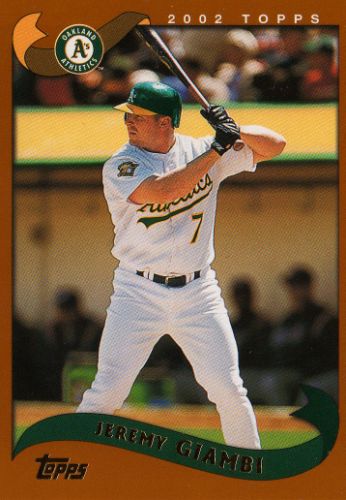
Now, before you come after me with pitchforks and torches, I swear I did my research, and no, I'm not talking about Jason, Adam, and Cal Jr respectively. Each of these three stellar infielders each had decidedly less stellar (says the guy blogging about other people instead of telling his own baseball stories) younger brothers who each saw varying amounts of playing time in the Majors: Jeremy Giambi, Andy LaRoche, and Billy Ripken.

Jeremy, soon before his trade to Philly.
Jeremy is sadly most famous for not only being Jason's little brother, but having the extremely unenviable task of trying to replace his big brother after Jason bolted Oakland for the greener pastures of the New York Yankees in 2002, and perhaps even sadder, for being on the wrong end of one of the most confounding defensive plays in post-season history, when iconic Yankee shortstop Derek Jeter seemingly materialized in foul territory, rescuing an errant relay throw and flipping it to also-iconic Yankee catcher Jorge Posada, who just managed to graze not-nearly-as-iconic Athletic first baseman Jeremy Giambi before he could score the tying run in the 2001 ALCS. Hey, at least he was playing in the 2001 ALCS though, right? A general need to beef up the lineup led Billy "Moneyball" Beane to trade Jeremy to the Phillies for utility-man John Mabry in May of the following season. Giambi would be out of baseball completely by 2005, with a career average of .263 with 52 HR and 209 HR in 510 games with four teams.

Andy, during his stint in Pittsburgh
Andy LaRoche, like so many guys in the league, has numbers that tell the tale of a career that has never really gotten off the ground. Expectations were certainly there at the outset though: he is the son of two-time All Star California Angels pitcher Dave LaRoche, and the brother of Gold Glove, Silver Slugger, and All-Rookie first baseman Adam LaRoche. To make that sibling rivalry even richer, the LaRoche brothers were teammates on the Pittsburgh Pirates in 2008 and 2009, with Adam manning first and Andy holding down third. While Andy finds himself a free agent at the moment (his most recent stint was a minor league contract within the Toronto Blue Jays organization), he can at least hold a gold medal in the 2007 Baseball World Cup over his brother's head. Hey, small victories, right? His current stats sit at .226 with 22 HR and 113 RBI over six seasons.


Billy Ripken's infamous Fleer card
Perhaps the hardest act to follow, the hardest big brother to share a name and the associated pressure with, is Cal Ripken though, no? Ironman. The Hall of Famer. The Champion. The two-time MVP. Like Andy and Adam, Billy and Cal were even teammates: Billy played for the Orioles from 1987-1992, and again in 1996. Cal Jr, as you know, spent his entire career (1981-2001) wearing Baltimore orange, as did their father, Cal Sr, who either coached or managed the O's from 1976-1992. Something in the water, hon. While Billy may never have the legendary numbers enjoyed by his older brother, he was responsible for one of the cheekiest moments in baseball card history. In 1989, he posed for a Fleer baseball card with a bat in his hand. It's a common pose, one seen on countless cards before and since, right? Well, Billy and his locker-room humor decided to spice it up a bit, scrawling the phrase Fuck Face on the knob of his bat in permanent marker. Inexplicably this initially made its way past the censors, and has become an incredible collector's item in its original, untouched state. Billy, always the spitfire, later quipped: "I think not only did they see it, they enhanced it. That writing on that bat is way too clear. I don't write that neat. I think they knew that once they saw it, they could use the card to create an awful lot of stir." Ripken found himself largely in journeyman status, playing 912 games in 12 seasons (an average of 76 per season). His final season was in 1998 with the Detroit Tigers, having slugged 20 HR and driven in 229 RBI with a .247 average.

Saturday, July 7, 2012

Youth is Served

Bryce Harper. Before his April 2012 debut for the Washington Nationals, the team that selected him first overall in the 2010 MLB amateur draft, he was labeled by some as a phenom and others as a villain. He was given expectations to be an instant Hall of Fame entry, or the worst MLB draft bust since the Florida Marlins selected Josh Booty in 1994. This child, this boy, this kid from Nevada, would either be Babe Ruth or Casey at the Bat. There would be no middle ground.

Bryce Harper: All-Star. Photo courtesy MissChatter, flickr
On July 7, less than three months into his rookie season, Harper has eight home runs, twenty-five RBI, a .283 average and an OPS (On-base Plus Slugging) of .830 -- only six rookies have more home runs, and only one rookie has better average, OPS, and RBI numbers (Mike Trout, LA Angels, .347, .962, 39). Mike Trout is twenty years old. Bryce Harper? Only nineteen.

See, baseball has never quite seen anything like Harper before. Two seasons after the Washington Nationals wowed the country with the spectacular pitching of Stephen Strasburg, they do it again on the bat, hustle, and swagger of Bryce Harper. With his last-minute selection as an injury replacement for Giancarlo Stanton (RF - Miami Marlins) in the 2012 MLB All-Star Game, Harper becomes the youngest position player selected, as well as the third-youngest player ever: only Dwight Gooden and Bob Feller were younger, and by a collective thirty-one days.

The selection could not come without a bit of serendipity, of course. Harper finished third in the Final Voting for the last roster spot for the National League, behind St. Louis third baseman David Freese and Atlanta outfielder Michael Bourn. His selection as an injury replacement can only be made by the National League's manager, retired Cardinals manager Tony LaRussa, who won a World Series with the Cardinals in 2011. Freese's spot in the game was secured by winning the Final Vote, and Bourn earned his spot earlier this afternoon with the withdrawal (due to injury) by Harper's teammate, shortstop Ian Desmond. Had Giancarlo Stanton not required arthroscopic surgery on a troublesome right knee, we would be talking about the impressive numbers of Harper, and the numerous All-Star games many expect him to participate in, perhaps even his candidacy for the NL Rookie of the Year. However, his numbers have already been bolstered by a rookie year All-Star Game selection, something that only two other teenagers have ever accomplished. For those who wonder if he's earned it, if maybe the spot should be reserved for a more accomplished player? Come on. That's a clown question, bro.

Friday, June 1, 2012

This One Isn't Really About Baseball.

Writer's Note: I know this isn't the tone this blog typically takes, and the length will be much greater, and there won't be any pictures. I know it's going to seem disjointed, stream of consciousness, muddled. Perhaps this one is for me, and for that, I apologize. But writing will always be a vanity project, to an extent, and I need you all to indulge me, just this one. Consider it another origin story, perhaps a chance to understand why this blog even exists in the first place. The events here are all real, but some names have been changed.

It isn't a lineup card, or a set of baseball cards, or your first foul ball. It isn't the smell of fresh grass, that weird gummy feeling on your hands from the pine tar. It isn't your first soaring victory, or your first defeat, hanging solid in your gut, inexorable, unrelenting.

It's none of these things, and yet, all of these things.

It's the first time your dad takes you out to play catch, the first time your brother teaches you how to throw a sliding curve. It's the first time you take a girl to a ballgame, and the first time you meet your favorite player.

It's the first time you use baseball to get through life. Through loss, through grief, through confusion, rage, hatred, fear.

Baseball, for so many of us, isn't just a game. It's not a sport, it's not a pastime, it's not even a way of life. For so many of us, player and fan alike, baseball is a tool of understanding. Baseball is what we use to make sense of a breakup, a college rejection, a firing. It's how we bond with a good friend, and how we cope with the loss of another. Baseball isn't our lives, in fact it's quite the opposite. Baseball is life's handbook. It's what we turn to when the proverbial engine won't turn.

I remember the exact moment that baseball stopped being a sport for me, and became a means of therapy.

On September 12, 2001, right around two a.m., I heard from my dad. If it had been September 8, September 9, September 10, this wouldn't have mattered. I would have been confused as to why he was waking me, but hearing his voice would not have led to sudden, hysterical, inconsolable tears of pure, unadulterated joy, and grief, and loss, and...And. And, and, and.

I wanted to hear my dad's voice more than anything else in the world. More than I wanted Sarah Stone to kiss me after school, more than I wanted to learn how to drive, more than I wanted Vicky Cunningham's black Mustang. I wanted to hear his voice, with or without his trademark stoicism, more than I have ever wanted anything in my life. I wanted to hear him scared, confused, angry, calm, happy...anything. Even if he was telling me things weren't going to be alright, I wanted to hear his voice.

I wasn't ready for what I heard, and to this day, only a few people have ever seen me cry so intensely, so violently, so wholly as I did that morning. With a game of Triple Play Baseball paused on the screen, and my best friend sitting silently next to me, I wept as my father told me

Nick, it's Dad. I'm not hurt, I'm not injured, but I can't come home right now. I love you and your mom and your brothers very much, and I will be home soon, but I can't come home yet.


For the next four hours, until exhaustion overtook us and sleep became more important than a match-up between the Cubs and Cardinals (Braves and Astros, Yankees and Red Sox, Expos and...), my best friend and I ignored that my dad was shuffled away in an emergency command post somewhere, feigning calm while the world burned. We played inning after inning, game after game, because baseball needed to matter more than my dad. At that point, baseball was the only thing in my life, because I didn't know how fit anything else in.

On September 23, 2001, right around the fifth inning, Cal Ripken hit his last major league home run, and he did it against the New York Yankees. I remember sitting in the stands, hearing the stadium erupt with the most cathartic cheering...we knew this was Cal's night. We knew he was retiring, we knew he had given us 3,001 games (2,632 consecutively), and we knew he wasn't a Yankee. After 12 horrible days in September, Cal gave us a reason to make it about baseball again. Cal made it okay to boo the Yankees, if only tonight. We had wept on the 11th, we had wept earlier that evening during the National Anthem. Now, we cheered. We hugged each other a little closer, and we cheered. When Cal's home run sailed over that outfield wall, a vicious wound came one stitch closer to healing. When Cal's foot touched home plate, when it could be Yankees/Orioles instead of the New York area against the DC area...we all realized that we had survived.

When Opening Day arrives each season, I will admit to tearing up. I take the day off of everything else, just as I have since turning 18. I don't even take my birthday off work, but I will never miss opening day. I sit in the stands, or at home, and I watch. I watch because sometimes you win, sometimes you lose, and sometimes it rains. But sometimes, you realize that it's okay that life often makes no sense. In the end, we'll have what we need as long as we have a sliding curve, a solid catch and throw, and a good crowd to share them with.

It was never really about baseball, but in the end, that's all it was, because that's all it ever needed to be.

Friday, May 18, 2012

One Final Strikeout, One Final Goodbye

No one thought it would end like this. 0-2, an 8.69 ERA, and the Chicago Cubs languishing at 15-24, a record good enough to land them in the cellar. We thought his career would end with a ring, a Cy Young award or two, perhaps an MVP award. Not like this.

When we were introduced to Kerry Wood in May of 1998, we didn't think it would start like this, either. The Cubs had never had a Rookie of the Year winner as a pitcher, despite notching three ROYs in team history at this point (Billy Williams-OF-1961, Ken Hubbs-2B-1962, Jerome Walton-OF-1989). When Kerry Wood took the bump on 5/6/98, he was nursing a 2-2 record with a 5.89 ERA and 25 strikeouts. His longest MLB outing to date had been seven innings, an 8-3 win over the rival St. Louis Cardinals. Coming into that May game, the Cubs were facing the first place Houston Astros. We weren't expecting much.

Two hours and nineteen minutes later, Kerry Wood had one-hit the first-place Astros, adding twenty strikeouts en route to a 2-0 win. To date, Wood is the only rookie to ever strike out twenty batters in a game. The Astros managed only two baserunners: Ricky Gutierrez with a single, and Craig Biggio with an HBP. To date, Wood is only one of four pitchers with at least 20 strikeouts in one game. Roger Clemens did it twice, Randy Johnson did it once, and Tom Cheney managed a 21-strikeout game in 1962. By the time Wood's rookie season was done, he had won the ROY after a 13-6 record, 233 strikeouts, 3.40 ERA and a K/9 innings pitched ratio of 12.6--best in baseball. We had no idea it would start like this.


In his first five full seasons (he missed the '99 season while recovering from Tommy John surgery) he averaged 213 strikeouts per season and a 12-8 record. He drew more than twice as many strikeouts than walks, threw five shutouts, and averaged ten strikeouts per nine innings of play, including a staggering 266 strikeouts in the 2003 season.

After that magic season, however, something went wrong. Some blame it on Dusty Baker for over-pitching the kid and wearing down his arm. Some blame the Bartman Curse, calling his downturn a byproduct of that fateful foul ball in the 2003 NLCS. Others still just said it was bound to happen. A natural progression for a fastball pitcher who averaged more than 180 innings per season.

Whatever the reason, something was up. While his shift to the bullpen as a closer was by no means unsuccessful--62 saves in three seasons--these numbers dropped each season: 34, 20, 8. He found himself on the disabled list fourteen times in thirteen seasons, and was relegated to middle relief in his final two seasons in Chicago. We didn't think it would end like this.

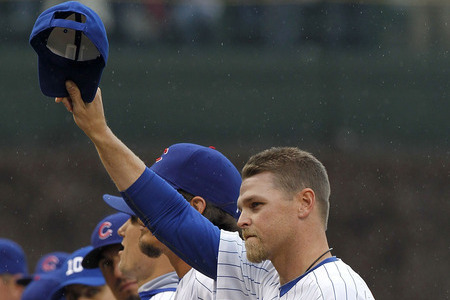
But even this story had a happy ending, because the baseball gods watch every pitch. When we received the shocking news before the game on 5-18-12 that it would be Wood's final game, the attitude was shock, sadness, confusion, perhaps even anger. Like this? Now? Not like this. No. No. But damn it, this was Kerry Wood. This was the man whose initials spelled K-W: Strikeout Win. When Strikeout Win retired, he did it on his own terms: an eighth inning swinging strikeout on an offspeed pitch to the White Sox' Dayan Viciedo.

Then, with a paying crowd of 34,937 on their feet, jubilant, grieving, worshiping: Kerry reminded us this has always been a child's game. He raised his cap to the fans, took a step towards the dugout, and hugged his six-year-old son Justin. We always knew it would end like this.


There will always be baseball. Suns will rise, moons will fall, and the Cubs will always be that team of highest infamy. It is this writer's belief, however, that we will never see another Kerry Lee Wood. A legend walked off the field today, exited those doors at 1060 West Addison for the final time as a player, and left a legacy that will forever be unmatched. Thank you, Kerry. From all of us, forever.

Photo Courtesy: Gregory Shamus, Getty Images

Wednesday, November 16, 2011

A Dodger, a Tiger, a Dazzy and a Senator - Pitching's Triple Crown


Now, this is the rare post I’ll write where the information provided is not just potential news to the reader, but to me as well. It’s true, there seem to be statistics and analysis for everything in baseball these days (how many of you can define WAR, BABIP, or FIP?), and I of course knew that the offensive Triple Crown existed. However, I had never realized that baseball awards the same trophy in pitching, and it is far more commonly distributed.

The original Triple Crown is an award given to hitters dominant enough to lead their respective league (American or National) in batting average, home runs, and RBI. This is a feat so rare that the last winner was, well, crowned in 1967. Left fielder Carl Yastrzemski took the honor, notching 44 home runs, 121 RBI, and a .326 average while playing for the Boston Red Sox. The last National League winner was Joe Medwick, another leftfield slugger who played for the St. Louis Cardinals, achieving the feat in 1937 with a .374 average, 31 homers, and 154 RBI. Some say that the increased focus on dominant pitching means we may not see another offensive Triple Crown winner for years.
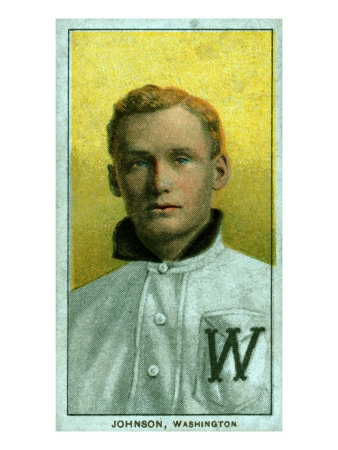
Walter Johnson

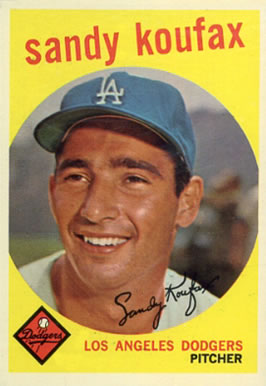
Enter the pitching side of the game. While there have only been 16 batting Triple Crowns awarded (with Rogers Hornsby and Ted Williams each winning a pair), there have been a staggering 38 pitching Triple Crowns distributed. Even more impressive are the number of repeat winners: seven have won it at least twice, while Walter Johnson, Sandy Koufax, and Grover Cleveland Alexander each managed to win three, with Koufax winning it in consecutive seasons in 1965-66.

2011 is a milestone in itself, as it is the first season since 1924 to have two pitching Triple Crown winners in the same season: Justin Verlander of the Detroit Tigers (2.40 ERA, 24 W, 250 K) and Clayton Kershaw of the Los Angeles Dodgers (2.28 ERA, 21 W, 248 K). The ’24 winners were Walter Johnson of the AL’s Washington Senators (2.72 ERA, 23 W, 158 K) and Dazzy Vance of the NL’s Brooklyn Robins (2.16 ERA, 28 W, 262 K).

Statistically, there is plenty to dive into here. While there have been 38 Triple Crowns awarded to pitchers, only ten have occurred since 1972—one would be wise to remember at this juncture that the pitcher’s mound was lowered from fifteen inches to ten in 1969 to foster a more offensively-oriented game. However, the split between AL and NL pitchers is even at five wins during that time, showing that there was likely no advantage pitching-wise in either league. Dwight Gooden’s win in 1985 was the lowest qualifying ERA (1.53) since Walter Johnson’s 1.27 mark in 1918, still with the Washington Senators.
Justin Verlander

However, the dominance displayed by Justin Verlander since his first full season in 2006 is almost unprecedented since the dawn of the new century. Randy Johnson was the last pitcher to notch 24 wins, achieving this in 2002 with the Arizona Diamondbacks. His two seasons of at least 250 strikeouts have yet to be matched by any other AL pitcher this decade. He has finished in the top five in Cy Young voting at least three times (including his win this year), won the 2006 AL Rookie of the Year award, and appeared in four All-Star games—did I mention he’s only been pitching full-time since 2006?

Clayton Kershaw
Clayton Kershaw’s 2011 accomplishments in the National League are no less impressive. His 248 strikeouts led the next-best pitcher (Cliff Lee, Phillies, 238) by ten. He was tied with Diamondbacks pitcher Ian Kennedy for wins at 21, while his 2.28 ERA was lower than the next closest (Roy Halladay, Phillies, 2.35) by seven points. No NL pitcher allowed less hits (174), while only five pitchers allowed less than Kershaw’s 54 walks. Only two NL pitchers threw more innings than Clayton’s 233.1, showing that not only did he assert dominance over the course of a season, but did so while surely battling a high level of fatigue. Justin Verlander, by comparison, threw a staggering 251 innings, leading the AL in innings pitched.

There is much debate since the dawn of the steroid era as to whether baseball will ever see a focus on the pitcher, whether we will ever witness another season like 1968, dubbed the Year of the Pitcher (Yastrzemski was the ONLY batter to crest a .300 average in the American League). The MLB-wide batting average was .231, an all-time low. Two pitchers reached sub-2.00 ERAs, with Bob Gibson achieving an as-yet-unmatched (and as-yet-incomprehensible!) 1.12 ERA. However, with the numbers put out by Kershaw and Verlander this season—perhaps set forth by greater enforcement and paranoia regarding steroid use—we may be returning to a more defensively-minded game. As a guy who loves pitching, I am one blogger who certainly hopes so.

Wednesday, August 24, 2011

Prime Time and Tecmo: Baseball's Two-Sport Stars

"The hardest thing to do in baseball is to hit a round baseball with a round bat, squarely." - Ted Williams

"Football is like life - it requires perseverance, self-denial, hard work, sacrifice, dedication and respect for authority" - Vince Lombardi

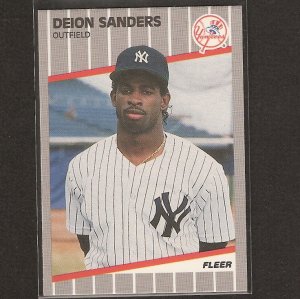
Deion Sanders and Bo Jackson managed multi-year careers in two of America's most popular sports, and were stars on both fields of play. The move is certainly not unheard of. Many of today's professional baseball players were also stars in other sports on the collegiate level, including Chicago Cubs reliever Jeff Samardzija (WR at Notre Dame) and San Francisco Giants utility player Mark DeRosa (QB at UPenn). Former outfielder Brian Jordan (Cardinals, Braves, Dodgers, Rangers) even had a career as a defensive back in the NFL, playing with the Atlanta Falcons from 1989-1991.

However, few had the immediate impact and success in both sports that were shared by Sanders and Jackson. 

Deion, in his rookie season in the Bronx.
Deion earned himself the nickname "Prime Time" for his flashy play and boisterous personality as a cornerback (1989-2005) for the 49ers, Cowboys, Falcons, Redskins, and Ravens, as well as an outfielder (1989-2001) for the Braves, Yankees, Reds, and Giants. Apart from a recent induction into the NFL Hall of Fame, two Super Bowl rings, 53 interceptions and 22 touchdowns, Sanders notched 558 hits, 186 steals, and a .263 batting average.
As if his speed hadn't been proven enough on the gridiron, Sanders led the National League with fourteen triples in 1992 as a member of the Atlanta Braves. His baseball numbers will never land him in Cooperstown, but his persona will never be forgotten. He is currently working with the NFL Network as an analyst, and is the star of his own reality show (Deion & Pilar: Prime Time Love) on the Oxygen channel. Also, while he may wish I didn't mention his musical career, Deion Sanders released a rap album in 1994 titled (what else?) Prime Time which was followed by a remix album The Encore Remix in 2005. Hey, you can't be an all-star everywhere, right?

"Tecmo" Bo Jackson earned himself the nickname thanks to an old NES video game Tecmo Bowl, in which he was programmed to be hands-down the most effective running back--and overall player--in the game. Jackson won the Heisman trophy as a member of the Auburn Tigers in 1985, and played his entire NFL career as a member of the Los Angeles Raiders from 1987-1990. Unlike Sanders, Jackson's career was much more successful on the diamond. Jackson broke into the majors as a member of the Kansas City Royals in 1986, where he stayed until 1990, before taking his talents to the Chicago White Sox from 1991-1993, and playing his final game in the strike-shortened 1994 season as a member of the California Angels. He was the All-Star Game MVP in 1989 (on the strength of a season in which he finished with 32 home runs, 105 RBI, and 26 steals, finishing 10th in MVP voting) and won the 1993 Comeback Player of the Year award in 1993. He finished his baseball career with 141 home runs, 415 RBI, a .250 batting average, and his trademark act of breaking the bat over his knee after a particularly frustrating strikeout. Arguably, Jackson's non-playing persona was bigger than his on the field. Nike's "Bo Knows" ad campaign capitalized on his freakish athletic ability, while he personally endorsed the NES game Bo Jackson Baseball and Gameboy game Bo Jackson's Hit & Run, which combined both sports into one game. He was also an unlockable character in the 2004 multi-console game NFL Street, as a member of the "Gridiron Legends." A showcase of the "Tecmo Bo" character can be seen below, courtesy of YouTube:


There is frequently talk of "the next Prime Time," or "the next Tecmo Bo," with athletes such as NFL tight end Tony Gonzalez trying out with the Miami Heat, and--of course--Michael Jordan's brief flirtation with professional baseball as a member of the Chicago White Sox minor league organization. However, if anyone manages to break into the professional realm in more than one sport, they will likely always be in the shadow of Tecmo and Prime Time, the standard bearers for diverse athleticism.