Saturday, July 7, 2012

Youth is Served

Bryce Harper. Before his April 2012 debut for the Washington Nationals, the team that selected him first overall in the 2010 MLB amateur draft, he was labeled by some as a phenom and others as a villain. He was given expectations to be an instant Hall of Fame entry, or the worst MLB draft bust since the Florida Marlins selected Josh Booty in 1994. This child, this boy, this kid from Nevada, would either be Babe Ruth or Casey at the Bat. There would be no middle ground.

Bryce Harper: All-Star. Photo courtesy MissChatter, flickr
On July 7, less than three months into his rookie season, Harper has eight home runs, twenty-five RBI, a .283 average and an OPS (On-base Plus Slugging) of .830 -- only six rookies have more home runs, and only one rookie has better average, OPS, and RBI numbers (Mike Trout, LA Angels, .347, .962, 39). Mike Trout is twenty years old. Bryce Harper? Only nineteen.

See, baseball has never quite seen anything like Harper before. Two seasons after the Washington Nationals wowed the country with the spectacular pitching of Stephen Strasburg, they do it again on the bat, hustle, and swagger of Bryce Harper. With his last-minute selection as an injury replacement for Giancarlo Stanton (RF - Miami Marlins) in the 2012 MLB All-Star Game, Harper becomes the youngest position player selected, as well as the third-youngest player ever: only Dwight Gooden and Bob Feller were younger, and by a collective thirty-one days.

The selection could not come without a bit of serendipity, of course. Harper finished third in the Final Voting for the last roster spot for the National League, behind St. Louis third baseman David Freese and Atlanta outfielder Michael Bourn. His selection as an injury replacement can only be made by the National League's manager, retired Cardinals manager Tony LaRussa, who won a World Series with the Cardinals in 2011. Freese's spot in the game was secured by winning the Final Vote, and Bourn earned his spot earlier this afternoon with the withdrawal (due to injury) by Harper's teammate, shortstop Ian Desmond. Had Giancarlo Stanton not required arthroscopic surgery on a troublesome right knee, we would be talking about the impressive numbers of Harper, and the numerous All-Star games many expect him to participate in, perhaps even his candidacy for the NL Rookie of the Year. However, his numbers have already been bolstered by a rookie year All-Star Game selection, something that only two other teenagers have ever accomplished. For those who wonder if he's earned it, if maybe the spot should be reserved for a more accomplished player? Come on. That's a clown question, bro.

Friday, June 1, 2012

This One Isn't Really About Baseball.

Writer's Note: I know this isn't the tone this blog typically takes, and the length will be much greater, and there won't be any pictures. I know it's going to seem disjointed, stream of consciousness, muddled. Perhaps this one is for me, and for that, I apologize. But writing will always be a vanity project, to an extent, and I need you all to indulge me, just this one. Consider it another origin story, perhaps a chance to understand why this blog even exists in the first place. The events here are all real, but some names have been changed.

It isn't a lineup card, or a set of baseball cards, or your first foul ball. It isn't the smell of fresh grass, that weird gummy feeling on your hands from the pine tar. It isn't your first soaring victory, or your first defeat, hanging solid in your gut, inexorable, unrelenting.

It's none of these things, and yet, all of these things.

It's the first time your dad takes you out to play catch, the first time your brother teaches you how to throw a sliding curve. It's the first time you take a girl to a ballgame, and the first time you meet your favorite player.

It's the first time you use baseball to get through life. Through loss, through grief, through confusion, rage, hatred, fear.

Baseball, for so many of us, isn't just a game. It's not a sport, it's not a pastime, it's not even a way of life. For so many of us, player and fan alike, baseball is a tool of understanding. Baseball is what we use to make sense of a breakup, a college rejection, a firing. It's how we bond with a good friend, and how we cope with the loss of another. Baseball isn't our lives, in fact it's quite the opposite. Baseball is life's handbook. It's what we turn to when the proverbial engine won't turn.

I remember the exact moment that baseball stopped being a sport for me, and became a means of therapy.

On September 12, 2001, right around two a.m., I heard from my dad. If it had been September 8, September 9, September 10, this wouldn't have mattered. I would have been confused as to why he was waking me, but hearing his voice would not have led to sudden, hysterical, inconsolable tears of pure, unadulterated joy, and grief, and loss, and...And. And, and, and.

I wanted to hear my dad's voice more than anything else in the world. More than I wanted Sarah Stone to kiss me after school, more than I wanted to learn how to drive, more than I wanted Vicky Cunningham's black Mustang. I wanted to hear his voice, with or without his trademark stoicism, more than I have ever wanted anything in my life. I wanted to hear him scared, confused, angry, calm, happy...anything. Even if he was telling me things weren't going to be alright, I wanted to hear his voice.

I wasn't ready for what I heard, and to this day, only a few people have ever seen me cry so intensely, so violently, so wholly as I did that morning. With a game of Triple Play Baseball paused on the screen, and my best friend sitting silently next to me, I wept as my father told me

Nick, it's Dad. I'm not hurt, I'm not injured, but I can't come home right now. I love you and your mom and your brothers very much, and I will be home soon, but I can't come home yet.


For the next four hours, until exhaustion overtook us and sleep became more important than a match-up between the Cubs and Cardinals (Braves and Astros, Yankees and Red Sox, Expos and...), my best friend and I ignored that my dad was shuffled away in an emergency command post somewhere, feigning calm while the world burned. We played inning after inning, game after game, because baseball needed to matter more than my dad. At that point, baseball was the only thing in my life, because I didn't know how fit anything else in.

On September 23, 2001, right around the fifth inning, Cal Ripken hit his last major league home run, and he did it against the New York Yankees. I remember sitting in the stands, hearing the stadium erupt with the most cathartic cheering...we knew this was Cal's night. We knew he was retiring, we knew he had given us 3,001 games (2,632 consecutively), and we knew he wasn't a Yankee. After 12 horrible days in September, Cal gave us a reason to make it about baseball again. Cal made it okay to boo the Yankees, if only tonight. We had wept on the 11th, we had wept earlier that evening during the National Anthem. Now, we cheered. We hugged each other a little closer, and we cheered. When Cal's home run sailed over that outfield wall, a vicious wound came one stitch closer to healing. When Cal's foot touched home plate, when it could be Yankees/Orioles instead of the New York area against the DC area...we all realized that we had survived.

When Opening Day arrives each season, I will admit to tearing up. I take the day off of everything else, just as I have since turning 18. I don't even take my birthday off work, but I will never miss opening day. I sit in the stands, or at home, and I watch. I watch because sometimes you win, sometimes you lose, and sometimes it rains. But sometimes, you realize that it's okay that life often makes no sense. In the end, we'll have what we need as long as we have a sliding curve, a solid catch and throw, and a good crowd to share them with.

It was never really about baseball, but in the end, that's all it was, because that's all it ever needed to be.

Friday, May 18, 2012

One Final Strikeout, One Final Goodbye

No one thought it would end like this. 0-2, an 8.69 ERA, and the Chicago Cubs languishing at 15-24, a record good enough to land them in the cellar. We thought his career would end with a ring, a Cy Young award or two, perhaps an MVP award. Not like this.

When we were introduced to Kerry Wood in May of 1998, we didn't think it would start like this, either. The Cubs had never had a Rookie of the Year winner as a pitcher, despite notching three ROYs in team history at this point (Billy Williams-OF-1961, Ken Hubbs-2B-1962, Jerome Walton-OF-1989). When Kerry Wood took the bump on 5/6/98, he was nursing a 2-2 record with a 5.89 ERA and 25 strikeouts. His longest MLB outing to date had been seven innings, an 8-3 win over the rival St. Louis Cardinals. Coming into that May game, the Cubs were facing the first place Houston Astros. We weren't expecting much.

Two hours and nineteen minutes later, Kerry Wood had one-hit the first-place Astros, adding twenty strikeouts en route to a 2-0 win. To date, Wood is the only rookie to ever strike out twenty batters in a game. The Astros managed only two baserunners: Ricky Gutierrez with a single, and Craig Biggio with an HBP. To date, Wood is only one of four pitchers with at least 20 strikeouts in one game. Roger Clemens did it twice, Randy Johnson did it once, and Tom Cheney managed a 21-strikeout game in 1962. By the time Wood's rookie season was done, he had won the ROY after a 13-6 record, 233 strikeouts, 3.40 ERA and a K/9 innings pitched ratio of 12.6--best in baseball. We had no idea it would start like this.


In his first five full seasons (he missed the '99 season while recovering from Tommy John surgery) he averaged 213 strikeouts per season and a 12-8 record. He drew more than twice as many strikeouts than walks, threw five shutouts, and averaged ten strikeouts per nine innings of play, including a staggering 266 strikeouts in the 2003 season.

After that magic season, however, something went wrong. Some blame it on Dusty Baker for over-pitching the kid and wearing down his arm. Some blame the Bartman Curse, calling his downturn a byproduct of that fateful foul ball in the 2003 NLCS. Others still just said it was bound to happen. A natural progression for a fastball pitcher who averaged more than 180 innings per season.

Whatever the reason, something was up. While his shift to the bullpen as a closer was by no means unsuccessful--62 saves in three seasons--these numbers dropped each season: 34, 20, 8. He found himself on the disabled list fourteen times in thirteen seasons, and was relegated to middle relief in his final two seasons in Chicago. We didn't think it would end like this.

But even this story had a happy ending, because the baseball gods watch every pitch. When we received the shocking news before the game on 5-18-12 that it would be Wood's final game, the attitude was shock, sadness, confusion, perhaps even anger. Like this? Now? Not like this. No. No. But damn it, this was Kerry Wood. This was the man whose initials spelled K-W: Strikeout Win. When Strikeout Win retired, he did it on his own terms: an eighth inning swinging strikeout on an offspeed pitch to the White Sox' Dayan Viciedo.

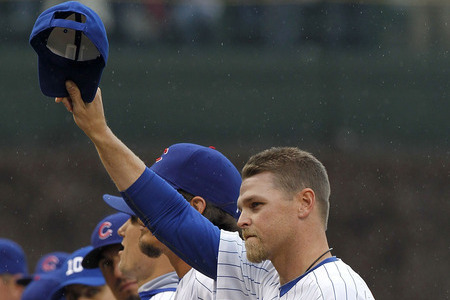
Then, with a paying crowd of 34,937 on their feet, jubilant, grieving, worshiping: Kerry reminded us this has always been a child's game. He raised his cap to the fans, took a step towards the dugout, and hugged his six-year-old son Justin. We always knew it would end like this.


There will always be baseball. Suns will rise, moons will fall, and the Cubs will always be that team of highest infamy. It is this writer's belief, however, that we will never see another Kerry Lee Wood. A legend walked off the field today, exited those doors at 1060 West Addison for the final time as a player, and left a legacy that will forever be unmatched. Thank you, Kerry. From all of us, forever.

Photo Courtesy: Gregory Shamus, Getty Images