Now, this is the rare post I’ll write where the information provided is not just potential news to the reader, but to me as well. It’s true, there seem to be statistics and analysis for everything in baseball these days (how many of you can define WAR, BABIP, or FIP?), and I of course knew that the offensive Triple Crown existed. However, I had never realized that baseball awards the same trophy in pitching, and it is far more commonly distributed.
The original Triple Crown is an award given to hitters dominant enough to lead their respective league (American or National) in batting average, home runs, and RBI. This is a feat so rare that the last winner was, well, crowned in 1967. Left fielder Carl Yastrzemski took the honor, notching 44 home runs, 121 RBI, and a .326 average while playing for the Boston Red Sox. The last National League winner was Joe Medwick, another leftfield slugger who played for the St. Louis Cardinals, achieving the feat in 1937 with a .374 average, 31 homers, and 154 RBI. Some say that the increased focus on dominant pitching means we may not see another offensive Triple Crown winner for years.
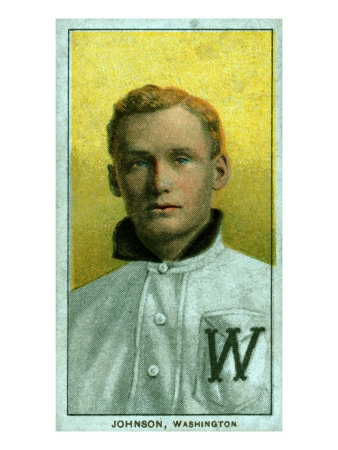 |
| Walter Johnson |
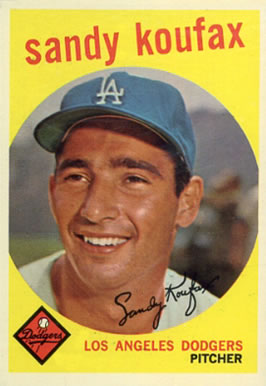
Enter the pitching side of the game. While there have only been 16 batting Triple Crowns awarded (with Rogers Hornsby and Ted Williams each winning a pair), there have been a staggering 38 pitching Triple Crowns distributed. Even more impressive are the number of repeat winners: seven have won it at least twice, while Walter Johnson, Sandy Koufax, and Grover Cleveland Alexander each managed to win three, with Koufax winning it in consecutive seasons in 1965-66.
2011 is a milestone in itself, as it is the first season since 1924 to have two pitching Triple Crown winners in the same season: Justin Verlander of the Detroit Tigers (2.40 ERA, 24 W, 250 K) and Clayton Kershaw of the Los Angeles Dodgers (2.28 ERA, 21 W, 248 K). The ’24 winners were Walter Johnson of the AL’s Washington Senators (2.72 ERA, 23 W, 158 K) and Dazzy Vance of the NL’s Brooklyn Robins (2.16 ERA, 28 W, 262 K).
Statistically, there is plenty to dive into here. While there have been 38 Triple Crowns awarded to pitchers, only ten have occurred since 1972—one would be wise to remember at this juncture that the pitcher’s mound was lowered from fifteen inches to ten in 1969 to foster a more offensively-oriented game. However, the split between AL and NL pitchers is even at five wins during that time, showing that there was likely no advantage pitching-wise in either league. Dwight Gooden’s win in 1985 was the lowest qualifying ERA (1.53) since Walter Johnson’s 1.27 mark in 1918, still with the Washington Senators.
 |
| Justin Verlander |
However, the dominance displayed by Justin Verlander since his first full season in 2006 is almost unprecedented since the dawn of the new century. Randy Johnson was the last pitcher to notch 24 wins, achieving this in 2002 with the Arizona Diamondbacks. His two seasons of at least 250 strikeouts have yet to be matched by any other AL pitcher this decade. He has finished in the top five in Cy Young voting at least three times (including his win this year), won the 2006 AL Rookie of the Year award, and appeared in four All-Star games—did I mention he’s only been pitching full-time since 2006?
.jpg/220px-Clayton_Kershaw_2010_(1).jpg) |
| Clayton Kershaw |
Clayton Kershaw’s 2011 accomplishments in the National League are no less impressive. His 248 strikeouts led the next-best pitcher (Cliff Lee, Phillies, 238) by ten. He was tied with Diamondbacks pitcher Ian Kennedy for wins at 21, while his 2.28 ERA was lower than the next closest (Roy Halladay, Phillies, 2.35) by seven points. No NL pitcher allowed less hits (174), while only five pitchers allowed less than Kershaw’s 54 walks. Only two NL pitchers threw more innings than Clayton’s 233.1, showing that not only did he assert dominance over the course of a season, but did so while surely battling a high level of fatigue. Justin Verlander, by comparison, threw a staggering 251 innings, leading the AL in innings pitched.
There is much debate since the dawn of the steroid era as to whether baseball will ever see a focus on the pitcher, whether we will ever witness another season like 1968, dubbed the Year of the Pitcher (Yastrzemski was the ONLY batter to crest a .300 average in the American League). The MLB-wide batting average was .231, an all-time low. Two pitchers reached sub-2.00 ERAs, with Bob Gibson achieving an as-yet-unmatched (and as-yet-incomprehensible!) 1.12 ERA. However, with the numbers put out by Kershaw and Verlander this season—perhaps set forth by greater enforcement and paranoia regarding steroid use—we may be returning to a more defensively-minded game. As a guy who loves pitching, I am one blogger who certainly hopes so.

No comments:
Post a Comment